






Weight and Your Knees: Why Every Kilo Counts Four Times
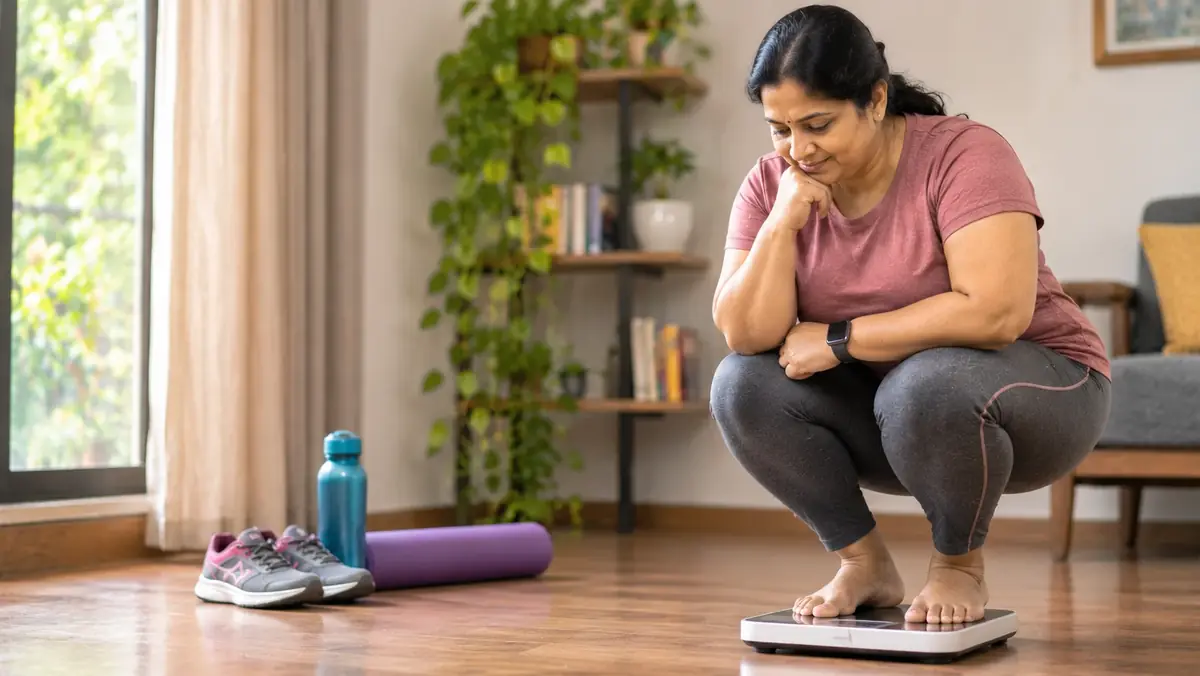
“Lose some weight” is probably the most common advice anyone with knee pain gets, and the most resented. I understand why. It often comes as a throwaway line at the end of a consultation, with no explanation and no plan, and it can feel like being blamed.
In my years in clinical practice, I had this conversation hundreds of times. What changed it was never the advice itself. It was the maths. Once people see what their weight actually does to their knees, they stop hearing it as a judgement and start seeing it as one of the most powerful tools they have.
So here’s the maths.
What your weight does to your knee
Your knee carries the weight of your whole body with every step, and the forces going through it are several times your body weight. Research from Wake Forest University’s ADAPT study found that every pound (about 0.45 kg) of weight lost led to roughly a fourfold reduction in the load on the knee per step [1][2].
Put simply: lose 5 kg, and you may take around 20 kg of force off your knees with every single step. Now think about how many steps you take in a day.
There’s a chemical side too. Fat tissue releases inflammatory substances, and weight loss through diet and exercise has been shown to lower inflammatory markers such as interleukin-6 [3].
Globally, high BMI contributed to roughly one in five cases of osteoarthritis [4]. In India, researchers list obesity as one of the main risk factors for OA that can be changed [5].
What happens when people actually lose weight
- The IDEA trial. In this 18-month randomised trial of overweight and obese adults with knee OA, people who combined diet-based weight loss with exercise had better pain and function than those who did diet alone or exercise alone. Average weight loss was 10.6 kg with diet plus exercise, 8.9 kg with diet alone, and 1.8 kg with exercise alone [3][6].
- How much is enough. Reviews of earlier work suggest that losing about 5% of your body weight brings some pain relief, and 10% roughly doubles that benefit [7].
- The guidelines agree. The 2019 ACR/Arthritis Foundation guideline strongly recommends weight loss for people with knee OA who are overweight or obese [8].
Look at that last number from the IDEA trial again. Exercise alone barely moved the scale. Exercise is essential for your knees in other ways, but when it comes to weight, you can’t out-walk your plate. Diet does most of the work on weight. Exercise protects the knee and keeps your muscle. You need both.
A safe, practical approach
- Set a realistic goal. Aim for 5–10% of your current weight over several months, at roughly 0.25–0.5 kg a week. For someone who weighs 80 kg, that’s 4–8 kg in total. Not a crash diet.
- Focus on food quality and portions. Yashashree’s article What Should I Eat for My Knees? has a practical, India-friendly plate.
- Keep your protein up and keep strength training, so you lose fat, not muscle. Muscle is your knee’s best friend.
- Choose knee-friendly activity: walking, cycling, swimming or water exercise, and physiotherapist-guided strengthening.
- Build habits, not rules. Weigh yourself weekly, not daily, and expect plateaus. Everyone hits them.
- Get professional support if you have diabetes, thyroid problems, heart or kidney disease, or take regular medicines.
Questions people ask me
“I can’t exercise because my knees hurt. Now what?” Start with seated and lying exercises, short walks and water-based activity, and let a physiotherapist progress you. Dr. Anand’s Exercises for Knee Osteoarthritis is a good place to begin.
“Will losing weight cure my arthritis?” It won’t reverse the cartilage changes. But it can significantly reduce pain and improve how well you move.
“Can I just diet?” Diet is the main driver of weight loss, but adding exercise gives extra benefit for pain and function.
“How much do I need to lose to feel a difference?” Even 5% of body weight is associated with some pain relief, and larger losses bring larger benefits.
“Are weight-loss medicines or surgery an option?” For some people with obesity, doctors may consider them. That’s a decision for you and your doctor, based on your overall health.
When to see a doctor
See your doctor if you gain weight quickly without explanation, lose weight without trying, or if your knee pain is severe, constant or waking you at night.
References
- Messier SP, et al. Weight loss reduces knee-joint loads in overweight and obese older adults with knee osteoarthritis. Arthritis Rheum. 2005;52(7):2026–2032.
- Wake Forest University. Treating knee osteoarthritis with intense weight loss and exercise (news release). 2006.
- Messier SP, et al. Effects of intensive diet and exercise on knee joint loads, inflammation, and clinical outcomes among overweight and obese adults with knee osteoarthritis: the IDEA randomized clinical trial. JAMA. 2013;310(12):1263–1273.
- GBD 2021 Osteoarthritis Collaborators. Global, regional, and national burden of osteoarthritis, 1990–2020 and projections to 2050. Lancet Rheumatol. 2023;5(9):e508–e522.
- Singh A, Das S, Chopra A, et al. Burden of osteoarthritis in India and its states, 1990–2019: findings from the Global Burden of Disease Study 2019. Osteoarthritis Cartilage. 2022;30(8):1070–1078.
- MDedge. Exercise-only plan yields less weight loss in obese, overweight OA adults (summary of the IDEA trial). 2013.
- The Rheumatologist. New findings for polymyalgia rheumatica, osteoarthritis (discussion of the WE-CAN and IDEA trials).
- Kolasinski SL, et al. 2019 ACR/Arthritis Foundation guideline for the management of osteoarthritis of the hand, hip, and knee. Arthritis Rheumatol. 2020;72(2):220–233.
This article is for general education and does not replace advice from a qualified doctor, physiotherapist or dietitian.