





Exercises for Knee Osteoarthritis: A Beginner’s Home Programme
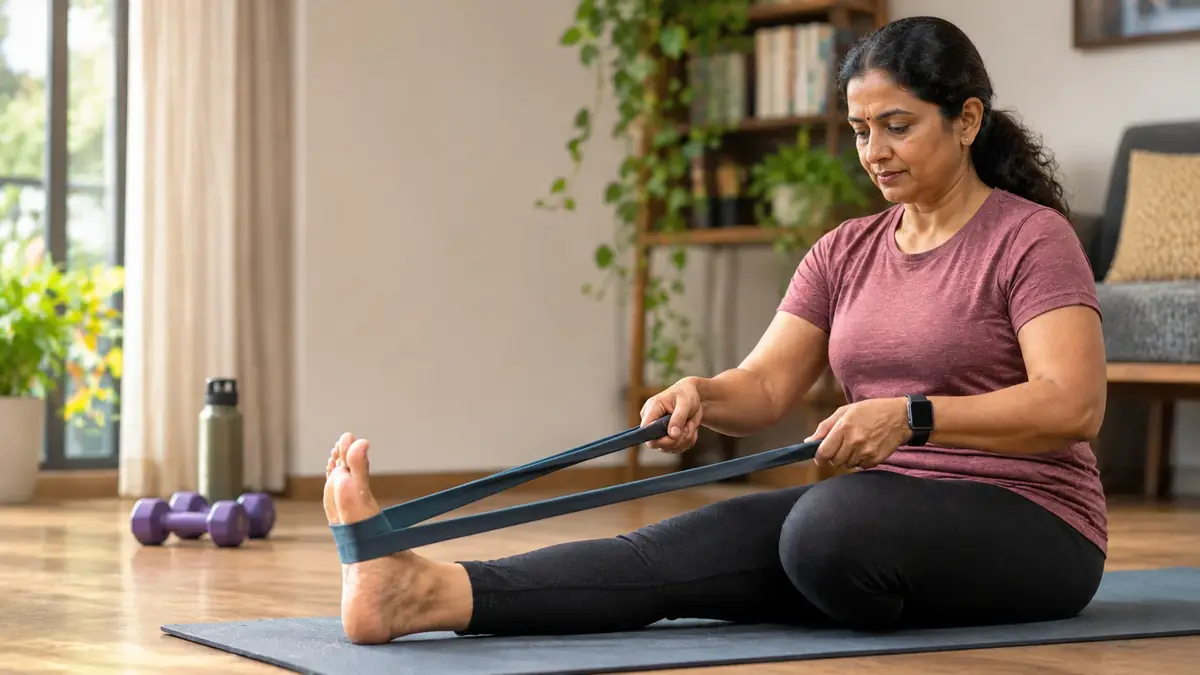
Most of my background is in sports rehab, and people are often surprised that the principles I use with an athlete coming back from a knee injury are the same ones I use with a 62-year-old with arthritis. Different starting point, different pace, same idea: a knee gets stronger when you load it sensibly and progressively.
When your knee hurts, resting it feels like the logical thing to do. For knee osteoarthritis (OA), the evidence points the other way. Exercise is one of the most strongly recommended treatments in international guidelines [1], and it’s one of the few things that improves both pain and function.
Does exercise really help?
Yes. A Cochrane review of randomised trials found that land-based exercise reduced knee pain by about 12 points on a 100-point scale and improved physical function by about 10 points straight after treatment, with benefit still present two to six months after formal treatment ended [2]. A much larger 2024 update, covering 139 trials and more than 12,000 people, still found that exercise improves pain and function, even if the size of the benefit is modest [3].
I’ll be honest about that word modest. Exercise isn’t magic. But it’s safe for most people when started sensibly, it costs very little, and the benefit keeps building for as long as you keep at it.
Exercise works by strengthening the muscles around the knee, especially the thigh muscles, which act as your knee’s shock absorbers. It improves how the joint handles load, supports weight control and reduces stiffness. In sports rehab we like to say “motion is lotion”. It’s a cliché because it’s true.
Before you start
- Some discomfort is normal. Mild to moderate discomfort during exercise is common and usually fine. Sharp pain, pain that stays much worse for more than a couple of hours afterwards, or new swelling means you should reduce the load.
- Don’t exercise a hot, red, rapidly swollen knee. See a doctor first.
- Check with your doctor first if you have heart disease, osteoporosis, recent surgery or a history of falls.
- Start small. Consistency beats intensity, every single time.
A simple check I give patients: rate your pain from 0 to 10. If it goes up a little while you exercise but settles back to where it was within a couple of hours, you’re in a good zone. If it’s still worse the next morning, we went too hard, and we dial it back.
Six beginner exercises
These are general examples to get you started. A physiotherapist should adjust them to your knee, your strength and your goals.
- Quadriceps set (sitting or lying). Sit with your leg straight. Tighten the muscle on the front of your thigh, gently pressing the back of your knee down. Hold for 5 seconds. Repeat 10 times. It looks too simple to matter. It matters.
- Straight leg raise. Lie on your back with one knee bent and the other leg straight. Tighten the thigh of the straight leg and lift it to the height of the bent knee. Lower slowly. Do 8–10 repetitions.
- Heel slide. Lying down, slowly slide your heel towards your buttock, bending the knee as far as is comfortable, then straighten it again. Do 10 repetitions to keep the knee moving.
- Sit-to-stand. From a firm chair, stand up and sit back down slowly, using your arms if you need to. Aim for 8–10. If I could only keep one exercise, it would be this one, because it’s exactly what you do every day.
- Glute bridge. Lie on your back with your knees bent. Squeeze your buttocks and lift your hips. Hold for 3–5 seconds and lower. Do 8–10 repetitions. Strong hips take pressure off the knee.
- Calf raise. Hold a kitchen counter, rise onto your toes, pause, and lower slowly. Do 10 repetitions.
How much: a common starting point is 1–2 sets of each exercise, three days a week, building to 2–3 sets as it gets easier. Add regular walking, starting with 10 minutes a day and slowly increasing.
Other activities that suit sore knees
The ACR/Arthritis Foundation guideline names walking, strengthening, neuromuscular training and water-based exercise as options for knee OA, and strongly recommends tai chi. Balance exercises and yoga are conditionally recommended [1]. Cycling and swimming are often well tolerated because they put less load through the knee, so if you have access to a pool or a stationary cycle, use it.
Staying consistent: the hard part
Getting the exercises right is the easy part. Doing them for eight weeks is where most people drop off. What helps:
- Attach your exercises to something you already do every day, like right after your morning chai.
- Mark each session on a calendar. A visible streak is surprisingly motivating.
- Expect gradual improvement over 6–8 weeks, not days.
- Get supervised if you can. The guideline notes that exercise is linked with better outcomes when supervised, and online physiotherapy trials have shown meaningful benefits [1][4].
When to stop and see a doctor
Stop and get medical advice for severe or worsening pain, a knee that locks or gives way, marked swelling, fever, pain or swelling in the calf, or pain that wakes you at night.
Quick answers
Should I exercise through pain? Mild discomfort is acceptable. Sharp or worsening pain is a signal to change the exercise or stop.
Are squats bad for arthritic knees? Not when they’re done right. Partial, controlled squats and sit-to-stands are used in rehab all the time. The depth and load should match your comfort, ideally guided by a physiotherapist.
References
- Kolasinski SL, et al. 2019 ACR/Arthritis Foundation guideline for the management of osteoarthritis of the hand, hip, and knee. Arthritis Rheumatol. 2020;72(2):220–233.
- Fransen M, McConnell S, Harmer AR, et al. Exercise for osteoarthritis of the knee: a Cochrane systematic review. Br J Sports Med. 2015;49(24):1554–1557.
- Lawford BJ, Hall M, Hinman RS, et al. Exercise for osteoarthritis of the knee. Cochrane Database Syst Rev. 2024;12:CD004376.
- Bennell KL, et al. Effectiveness of an internet-delivered exercise and pain-coping skills training intervention for persons with chronic knee pain: a randomized trial. Ann Intern Med. 2017;166(7):453–462.
The exercises described are general examples, not a personalised prescription. Consult a doctor or physiotherapist before starting.